

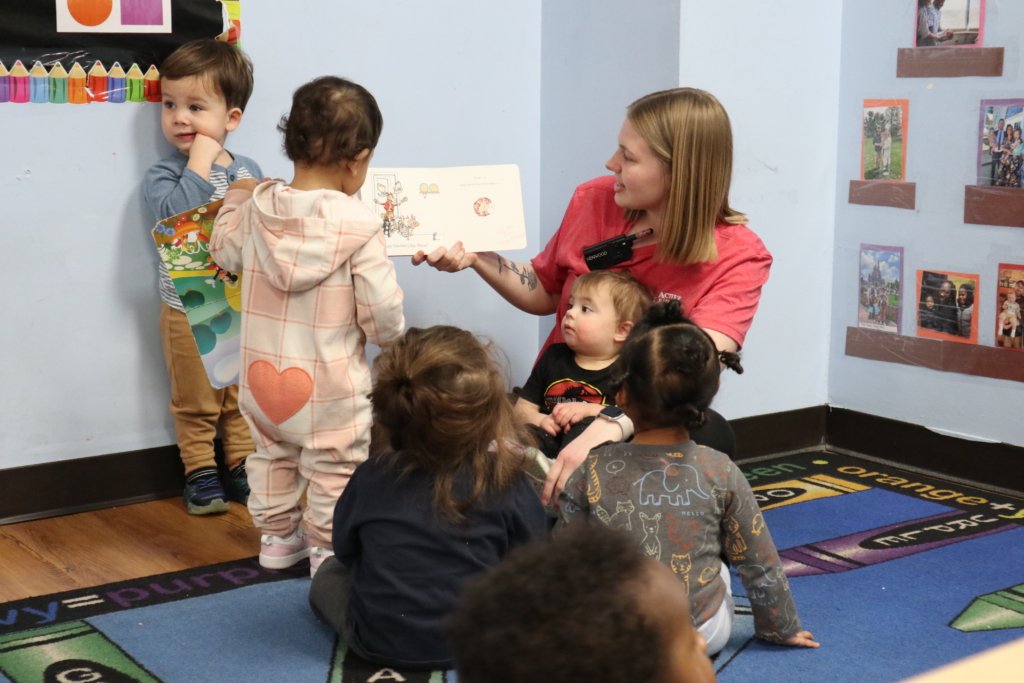
September is National Early Literacy Month, and at Active Learning Centers, we believe it is a wonderful reminder of something families can practice all year long:
Children begin becoming readers long before they can actually read.
Early literacy grows through conversations, songs, stories, movement, imagination, questions, and the countless little interactions children share with the people who care about them.
That is good news for families, because helping a child develop early literacy skills does not require worksheets, apps, flashcards, or long lessons.
In fact, some of the most meaningful learning happens when children are doing what childhood was made for—talking, moving, exploring, creating, playing, and connecting with the people around them.
At Active Learning Centers, that fits perfectly with the way we believe children learn best: actively, hands-on, and screen-free.
What Is Early Literacy?
Early literacy is much bigger than learning ABCs.
It includes the skills and experiences that prepare children to eventually read, write, communicate, understand stories, and express their own ideas.
When a baby listens to a familiar voice, a toddler sings a rhyming song, or a preschooler tells you what happened during their day, literacy development is already happening.
Pennsylvania’s PA Promise for Children highlights reading, talking, singing, and storytelling as important ways adults can help establish this foundation from the very beginning.
And there is an important word in that sentence: together.
Early literacy is not simply something we teach children. It is something we experience with them.
7 Screen-Free Early Literacy Activities Families Can Try
Here are seven simple ways families can make literacy part of everyday life without turning learning into another assignment.
1. Read Together—and Let Your Child Lead
Reading aloud is one of the simplest ways to surround children with language.
But reading together does not always have to mean finishing every word on every page.
Pause.
Look at the pictures.
Ask your child what they notice.
Let them turn the pages.
Wonder together about what might happen next.
If your toddler wants to talk about the dog on the page for three minutes, that conversation is valuable too.
Try asking:
- “What do you see?”
- “How do you think that character feels?”
- “What do you think will happen next?”
- “What would you do?”
- “Can you find something red?”
- “Can you show me the biggest animal?”
The goal is not to rush through a book. The goal is to help children think, communicate, connect, and enjoy the experience.
2. Talk About What You Are Doing
Some of the best literacy activities do not involve a book at all.
Children build vocabulary when caring adults talk with them throughout ordinary routines.
At the grocery store, talk about colors, shapes, quantities, foods, and signs.
On a walk, describe what you hear and see.
While making dinner, introduce words like pour, stir, measure, slice, and mix.
While getting dressed, compare textures, colors, sizes, and weather.
A simple trip across the parking lot can become:
“Those clouds look dark. What do you think the weather might do?”
That one question encourages observation, vocabulary, reasoning, prediction, and conversation.
Learning really is everywhere.
3. Add Movement to Songs and Rhymes
At ALC, we know children were not designed to spend childhood sitting still.
Fortunately, literacy does not require them to.
Songs, chants, rhymes, fingerplays, and movement games help children listen to the sounds and rhythms of language while staying active and engaged.
Try:
- Acting out “Itsy Bitsy Spider”
- Marching while saying the alphabet
- Clapping syllables in family members’ names
- Making up silly rhyming words
- Moving like animals from a favorite story
- Singing familiar songs faster, slower, louder, or softer
Children can develop language while their whole bodies are involved in the experience.
That is active learning at its best.
4. Bring a Book to Life
A story does not have to end when the book closes.
Turn it into an experience.
If you read about animals, move like the animals afterward.
If a character builds something, provide blocks and invite your child to create their own version.
If a story takes place outside, head outdoors for a scavenger hunt inspired by the book.
Ask your child to act out their favorite part.
You can even create a simple family “StoryWalk” by placing pages, pictures, or story prompts around the house or yard and moving from one to the next.
When children can hear it, see it, talk about it, move through it, and create from it, a story becomes much more than words on a page.
5. Let Your Child Become the Storyteller
Adults do not have to tell every story.
Invite your child to tell one.
Ask:
“What happened at school today?”
“Can you make up a story about this stuffed animal?”
“What adventure do you think we should go on?”
For younger children, ask questions and build the story together.
For preschool and Pre-K children, write down the story exactly as they tell it. Then read their words back to them.
Suddenly, children discover something powerful:
Their ideas can become words, and words can become stories.
That builds communication skills, confidence, imagination, and an understanding of why writing matters.
6. Connect Stories With Open-Ended Art
After reading a book, skip the identical craft where everyone’s finished project is supposed to look the same.
Instead, provide open-ended materials and invite your child to create.
Try asking:
“Can you make something inspired by our story?”
Then offer paper, crayons, paint, clay, recycled materials, blocks, or other age-appropriate supplies and see where their imagination goes.
Ask them to tell you about what they created.
You might hear an entire story you never expected.
At ALC, we believe the process matters more than the product. When children make their own creative decisions, they practice problem-solving, communication, fine-motor skills, confidence, and independence at the same time.
There is no single “right” picture.
The learning is in the creating.
7. Use Stories to Build Character
Books can also help children practice something just as important as academic readiness: becoming good humans.
Stories naturally introduce children to friendship, responsibility, honesty, courage, kindness, mistakes, problem-solving, and different perspectives.
After reading, ask questions such as:
- “Was that a respectful choice?”
- “What could the character do differently?”
- “How could we help that person?”
- “What would a responsible choice look like?”
- “How did the character solve the problem?”
- “What could they try next?”
These conversations help children connect stories to real life.
At Active Learning Centers, character development is not separate from learning. It is part of preparing children for school, friendships, challenges, and life.
Early Literacy Looks Different at Every Age
One of the beautiful things about literacy development is that families can support it from the very beginning.
Infants benefit from hearing caring voices, songs, repeated words, and short stories while exploring sturdy books and pictures.
Toddlers love repetition, rhymes, naming familiar objects, pointing to pictures, making sounds, singing, and choosing favorite books again…and again…and again.
Preschoolers are ready for longer conversations, predictions, storytelling, rhyming games, letter exploration, imaginative play, and questions about stories.
Pre-K children can begin making stronger connections between spoken and written language while developing vocabulary, comprehension, storytelling, letter awareness, and the confidence to express increasingly complex ideas.
The goal is not to push children ahead of their developmental stage.
The goal is to believe in them, encourage growth, and give them meaningful opportunities to keep becoming a better version of themselves.
Five Minutes Can Become a Learning Moment
Families are busy.
Early literacy does not need to become one more thing on a parent’s checklist.
You do not need elaborate materials.
You do not need a perfect reading corner.
You do not need an educational app.
You need connection.
Talk on the drive home.
Sing while cleaning up.
Tell stories during dinner.
Look for letters while walking through the neighborhood.
Read before bed.
Ask your child about their day—and really listen to the answer.
Those little moments add up.
Celebrate Early Literacy Month With ALC
National Early Literacy Month gives us another reason to celebrate books and language, but at Active Learning Centers, the bigger goal lasts all year:
Help children become curious, confident learners who are excited to discover what comes next.
Our classrooms are intentionally designed around active, hands-on, screen-free experiences that encourage children to communicate, create, problem-solve, build friendships, move their bodies, develop character, and prepare for the next stage of learning.
Because learning to read matters.
Learning to communicate matters.
Learning to think matters.
And who children become along the way matters too.
That’s what we mean by childcare with a purpose.
Looking for Child Care, Preschool or Pre-K in the Lehigh Valley?
Active Learning Centers serves families at locations throughout the Lehigh Valley, including Bethlehem Township, Emmaus, Fogelsville, Palmer, and Trexlertown.
Discover a place where children can learn, move, explore, build character, and feel like part of a family.
Schedule a tourof your nearest Active Learning Center and experience the ALC difference.
Additional Early Literacy Resource
Families looking for additional Pennsylvania early literacy ideas and resources can visit PA’s Promise for Children and its National Early Literacy Month resources.
This article was independently created by Active Learning Centers. PA’s Promise for Children was consulted as an educational resource regarding National Early Literacy Month and early literacy activities for Pennsylvania families.